

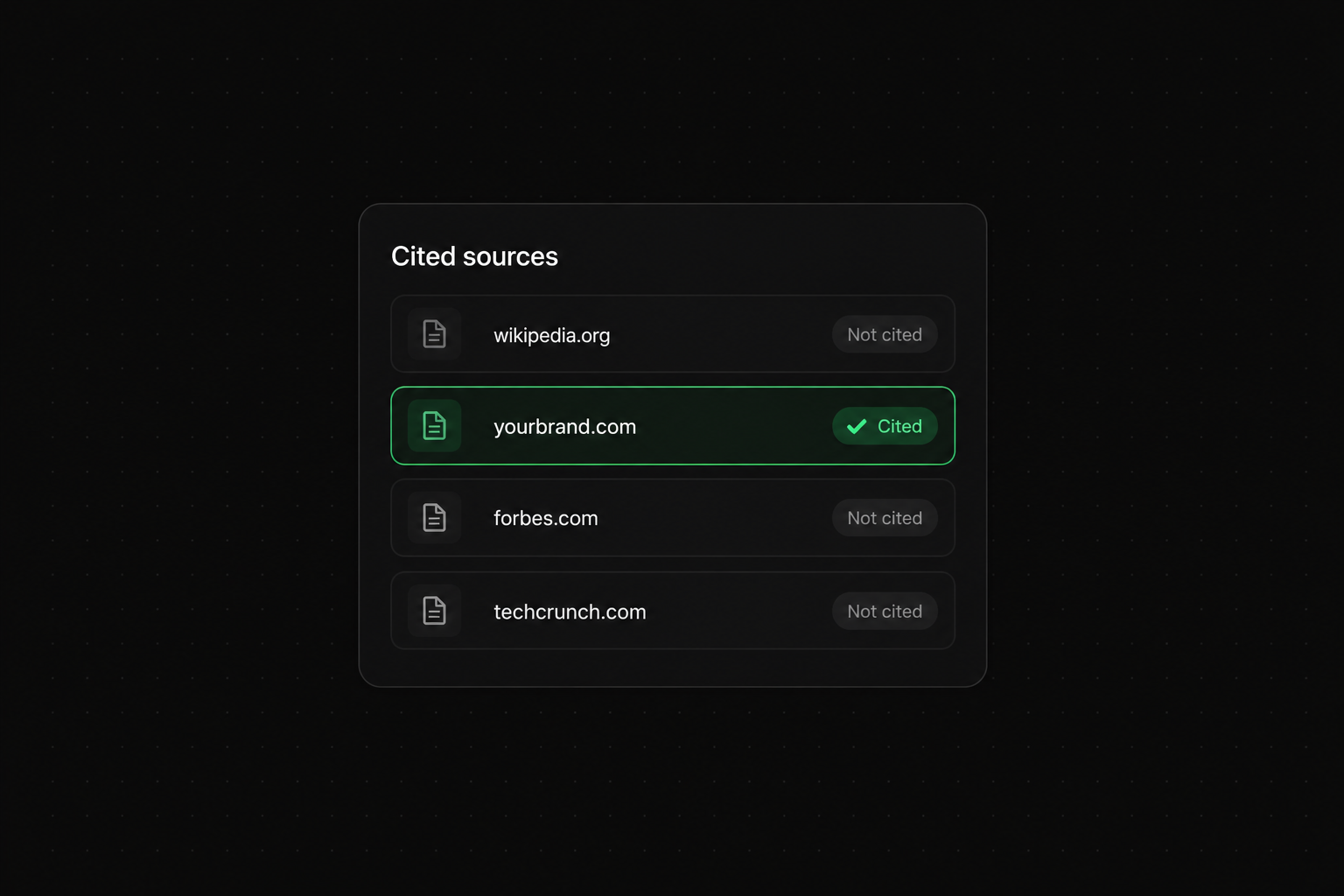
To improve your chances of being cited by ChatGPT, publish accessible pages that answer specific questions with accurate information and useful evidence. Then monitor relevant answers, inspect the sources they use, and improve the pages where your business can contribute something the reader needs.
There is no submission trick that guarantees a citation. A better approach is to work from the buyer's question backwards: what are they trying to decide, which information would help, and where can your website provide that information clearly?
This guide is for businesses that want their content to support AI answers and attract qualified visitors. It covers owned pages, accurate brand information, outside sources, measurement, and the route from an informative article to a relevant signup.
Define the outcome you want to earn
A citation is a link to a source used or presented in an answer. A brand mention names your company. A recommendation presents it as an option for a particular need. A click brings someone to your website. Those events can occur together, but they need different measurements.
Consider a fictional company called Northline Projects. ChatGPT might cite Northline's tutorial about project handoffs without recommending its software. It might recommend the software using an independent review instead. Both observations could be useful, but they tell the team different things.
If your objective is educational reach, a tutorial citation may matter. If your objective is product discovery, you also need to inspect whether the answer accurately explains who the product serves. If your objective is trial starts, the destination page and onboarding path matter as well.
Choose one primary objective for the first content cycle. That makes it easier to select the page, evaluate the result, and avoid celebrating a metric that has little connection to your business.
Start with a question your business can answer well
Choose questions close to your expertise. A payment product may explain reconciliation workflows. A logistics company may explain a delivery planning problem. A software platform may provide an honest implementation guide for a task it supports.
Use real customer language. Sales questions, onboarding obstacles, support tickets, and discovery interviews can reveal the detail people need before taking action. Google keyword research adds search context, but it does not establish the frequency of the same question inside ChatGPT.
Avoid starting with a broad ambition such as getting cited for marketing. Identify a specific task: how a small team should choose prompts to monitor, how to compare two reporting approaches, or how to diagnose an incomplete product description.
Write the intended reader and decision at the top of your working brief. A question is worth targeting when answering it helps a plausible customer and your team can contribute reliable information. A large search volume alone does not make the topic a good fit.
Review relevant answers and their sources
Collect answers to a small group of representative questions. Save the wording, date, platform settings, visible citations, and relevant excerpts. Use clean conversations for discovery tests so your earlier messages do not supply the brand you want to measure.
Open the cited pages. Identify the information each page contributes, rather than just compiling a list of domains. One source may explain a process. Another may provide a feature comparison or a concrete example.
Look for an actionable gap. If every useful answer explains a step your page omits, that is a reason to improve the page. If the sources are independent product reviews, publishing a longer vendor blog may not address the same need.
Do not treat one response as a stable source hierarchy. Repeat the observations under consistent conditions and look for patterns worth investigating. Your purpose is to understand the information requirement, not to copy a competitor's wording or imitate an answer mechanically.
Make the page accessible before optimizing its argument
Review the intended public URL with your technical owner. Check whether it delivers the expected content without an account, whether redirects reach the right destination, and whether the site's policy permits relevant search access.
OpenAI identifies OAI-SearchBot as its search crawler and publishes guidance for access. Allowing it is an access decision, not a promise of citation. OpenAI crawler documentation.
Make sure the page is connected to the rest of your website through useful navigation and relevant internal links. If the article is an isolated resource with no clear relationship to your services, address that editorial structure too.
Check the actual information delivered, not just whether the page looks attractive in your own browser. A technically successful page with a thin explanation still gives readers little reason to trust or use it. Access and content usefulness should each have their own review.
Give the reader a clear answer early
Start by answering the main question in ordinary language. Then explain the conditions and steps that make the answer useful. The opening should help a reader decide whether they are in the right place.
For example, a guide to choosing reporting software could start with the decision criteria: data sources, reporting needs, review workflow, and cost. The rest of the article can demonstrate how to apply those criteria.
Avoid opening with several paragraphs about how quickly the industry is changing. Readers who asked a practical question need help with the question. Establish the task and begin solving it.
This is an editorial recommendation, not a fixed formatting rule for an AI system. There is no universal sentence count that turns an introduction into a citation magnet. Choose the length needed to explain the answer accurately, including any important limits.
Add information that can be checked
Support important claims with evidence appropriate to the topic. A technical guide can show a tested process. A comparison can link to current product documentation. A case study can explain the situation, method, dates, and actual observed results.
Keep evidence close to the claim. If a feature requires a particular plan or integration, explain that condition beside the feature. If an example is hypothetical, label it where the reader encounters it.
Original information does not need to be a large research project. A careful walkthrough, a genuine implementation lesson, or a clearly explained calculation can make a page more useful. What matters is whether the reader can understand what was done and what the example establishes.
Google's people-first content guidance encourages original information and clear sourcing. That guidance concerns Google Search; use it as support for useful publishing practices without presenting it as a disclosed ChatGPT ranking formula. Google Search Central.
Show the difference between an assertion and an explanation
Imagine a fictional task management product page that says it makes collaboration effortless. That is a broad assertion. It gives a prospective buyer little detail to evaluate.
A stronger explanation could describe how an owner assigns a task, how a reviewer receives it, what happens when a deadline changes, and which record remains visible afterwards. Include the real product limitations that affect the workflow.
If your team publishes a screenshot, use an actual product state with sensitive information removed. If you write a sample scenario, label it illustrative. Do not create a pretend customer success result to make the example sound more persuasive.
The goal is to give the buyer a usable answer. A step-by-step explanation can also help your team spot gaps in the product page itself, including information that onboarding or sales staff currently explain repeatedly.
Keep brand facts consistent across your website
Review your homepage, platform pages, pricing, help center, and important company profiles. Check the business name, intended audience, supported markets, product capabilities, and any limits that matter to a buyer.
Inconsistency can confuse readers before any AI system becomes involved. If one page says an integration is available and another says it is planned, resolve the product fact. Do not rely on a blog article to quietly override contradictory documentation.
Make product language specific. Explain what the feature does, who uses it, and where it fits into the workflow. Keep slogans separate from operational facts.
For US and Canadian buyers, include relevant availability and currency information where appropriate. Avoid manufacturing separate location pages when the offering is identical and there is no local information to add. Use geography to clarify a real buying condition, not to multiply nearly identical content.
Build fair comparison and use case pages
A comparison should help the reader make a decision, including situations where your product may not be the best fit. Use consistent criteria and verify competitor facts against current official pages.
For a content platform, useful criteria might include research inputs, prompt coverage, editorial review, publishing connections, and reporting. Explain what is documented, what your team has tested, and which details may depend on the selected plan.
A use case page should describe an actual task. Show the inputs, decisions, actions, and output. That gives the buyer more value than a generic page repeating that the product is suitable for everyone.
Keep comparisons current. Assign an owner and a review date, particularly for price, usage limits, and available integrations. A citation to an outdated comparison may increase exposure while giving prospective customers the wrong information.
Treat outside sources as an accuracy and reputation task
Some questions call for independent context. Reviews, directories, trade publications, and customer stories may provide information your own website cannot supply in the same way.
First correct existing profiles you control. Use accurate categories, product details, and service areas. Request legitimate customer feedback through an appropriate process. Never write fabricated reviews or imply an endorsement a publisher has not given.
When pursuing editorial coverage, offer a useful contribution: original findings, an expert explanation, or a relevant case study with permission. The publication decides whether the material serves its readers.
Track outside coverage separately from owned citations. If an independent review supports a brand recommendation, record that relationship accurately. You can investigate which sources appear in your observed answers without claiming that one listing will guarantee inclusion.
Improve an existing page before creating a duplicate
Check your current content library for the same reader need. Questions such as appearing in ChatGPT, getting cited in ChatGPT, and ranking on ChatGPT may overlap enough to belong in one substantial guide.
Use a separate article when the purpose is distinct. A technical crawler tutorial can stand on its own because it helps someone debug access. A visibility gap diagnosis can stand on its own because it helps someone decide what to investigate.
Within the citation guide, cover related questions as useful sections and FAQs. Do not create five shallow pages that restate the same advice with different keywords.
Save a meaningful update record. Note what information you added, what you corrected, and the buyer question it serves. That creates a clearer basis for later evaluation than changing a publication date without improving the content.
Measure progress with a consistent response set
Keep a fixed set of questions for the first review period. Record the country, platform, relevant settings, and schedule. Preserve the old prompt version when you decide to change wording.
Measure your own domain citations separately from brand mentions and recommendations. If a source links to a different company with a similar name, investigate the ambiguity rather than counting it as a success.
Review the cited page and surrounding context. An inaccurate description or a link to an obsolete resource can reveal a problem even when the brand appears. Accuracy matters to the buyer who might visit.
Compare repeated observations after publication, while annotating other changes. If you launch a campaign, earn outside coverage, and update several pages at once, the results cannot neatly isolate the effect of one paragraph. Use the evidence to guide the next improvement without inventing a causal success story.
Give qualified visitors a useful next step
An informative article can create demand, but the reader still needs to understand why your product relates to the task. Introduce the product at the point where it helps them carry out the process.
Link to a relevant platform feature rather than sending every visitor immediately to a signup form. A reader comparing workflows may want to inspect capabilities first. A reader ready to implement can benefit from a direct onboarding invitation.
Keep the invitation honest. Explain the next task they can begin, such as organizing a prompt group or investigating a content gap. Avoid promising that creating an account will automatically get the business cited.
Use your analytics and CRM to review visits, trial starts, and account activation. Those measurements complement citation tracking; they answer a different business question.
Turn citation research into content work with SERPY
The SERPY platform brings the research and content stages into one workflow. AI Visibility lets you inspect tracked responses, cited sources, and competitor appearances around your selected questions.
Use Opportunity Discovery to investigate related search demand and gaps in your website. Then use Content Engine to outline, write, review, and improve the page selected for that need.
After publishing, Performance Tracking connects page performance with visibility signals. Keep your team's success criteria explicit so the workflow leads to an informed next decision.
Try SERPY for free to start with one buyer question, inspect the available evidence, and choose a useful page improvement.
Frequently asked questions
How do I get my website cited by ChatGPT?
Start with a relevant public page that answers a specific question well. Check access, improve factual detail and evidence, and monitor representative answers consistently. The process helps you identify controllable improvements. It does not provide a guaranteed citation or a fixed completion date.
Can I submit a URL and guarantee inclusion?
Do not treat any submission or indexing action as a guarantee of a particular answer. Focus on the public page's usefulness and the evidence you can verify. Track subsequent observations separately so a successful technical action is not confused with an earned citation.
What does ranking on ChatGPT mean?
People often use the phrase to mean being mentioned, recommended, or cited. Define the specific event before choosing a metric. A response to one prompt is not the same thing as a stable Google position across an entire keyword market.
Do citations and recommendations need different pages?
Sometimes they need different information, but they do not automatically require different URLs. A tutorial can answer an educational question, while a product page explains fit and capabilities. Plan each page around the reader's task and link them where the relationship is useful.
Should I publish a large number of AI articles?
Publish when you can answer a real buyer need with accurate and useful information. A large volume of repetitive articles creates more review work and may leave important questions unresolved. Start with the clearest gaps and maintain the quality of existing coverage.
Do I need original research?
Original research can help when it is relevant and methodologically clear, but it is not the only useful evidence. A tested walkthrough, documented comparison, or practical example can also serve the reader. Choose evidence your team can explain and maintain accurately.
Can an FAQ section help?
An FAQ section can answer related questions without interrupting the main explanation. Keep each answer specific and avoid repeating a keyword mechanically. Include the questions buyers actually raise, with qualifications where needed, rather than treating the section as a citation shortcut.
Should I add special schema for ChatGPT?
Do not present a markup change as a guaranteed ChatGPT citation method. Use appropriate structured data for its documented purpose and keep it consistent with the visible page. Prioritize useful information and accurate product facts when choosing the next editorial improvement.
Can third-party coverage matter?
It can provide independent information relevant to some buyer questions. Inspect the sources in your observed answers and distinguish outside coverage from links to your own site. Pursue accurate listings and legitimate editorial contributions without assuming a particular placement will produce a recommendation.
How should I handle US and Canadian content?
Separate the markets when geography changes availability, pricing, service areas, or buyer requirements. Otherwise, a shared guide may be sufficient. Add country-specific information because it helps the reader make a decision, rather than duplicating an article with a different place name.
How soon should I expect results?
Set a review schedule for your own workflow and compare repeated observations. Timing can vary, and a page update does not create a reliable citation deadline. Evaluate whether the content became more useful and accurate alongside any change in observed visibility.
How does SERPY help turn citations into signups?
SERPY helps investigate the questions, sources, and content gaps that can shape qualified discovery. Your articles and product pages still need a clear route to onboarding, and your analytics need to measure the outcomes. Try SERPY for free to begin that research and content workflow.