

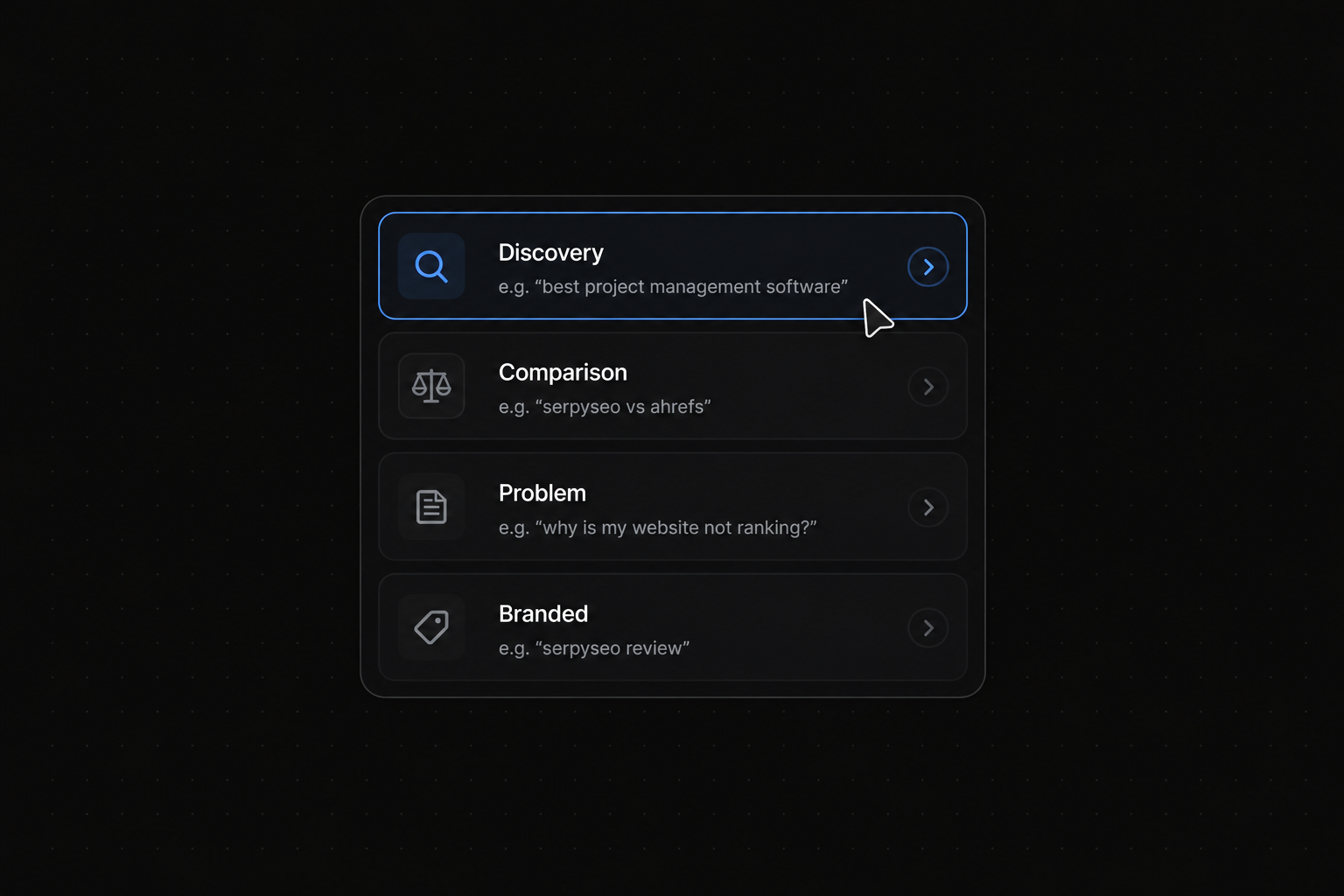
Choose AI visibility tracking prompts by working from the questions your buyers ask before they make a decision. Cover discovery, comparisons, practical problems, and brand accuracy. Keep the markets and testing conditions consistent so the answers tell you what to improve.
A useful prompt set helps your team make decisions. It can reveal a missing product explanation, an incomplete guide, a competitor comparison worth investigating, or inaccurate information about your business. A long list of loosely related questions can produce a large dashboard with very little direction.
This guide gives US and Canadian marketing teams a practical selection process and a starter template. You will learn how to collect customer language, distinguish branded from unbranded questions, remove duplicates, and turn observed responses into useful content work.
Define the buying decision you want to understand
Begin with one audience and one product or service. Write down who is evaluating the offering, what problem they need to solve, and what would make them a qualified customer.
For a content platform, the audience might be a small marketing team that needs to plan and publish useful articles. For a local service provider, it might be a property owner comparing contractors in a city the business actually serves.
Then identify the decisions involved. A buyer may need to understand the category, compare approaches, check a specific capability, estimate implementation effort, and decide whether to begin a trial.
Those decisions form the outline of your prompt set. If a question has no relationship to a plausible customer decision, put it in a research backlog rather than the core measurement group.
Keep the objective concrete. Understanding whether buyers discover your business for a particular use case is more manageable than trying to measure your visibility across every possible AI conversation.
Gather the language customers already use
Read sales notes, support requests, customer interviews, onboarding questions, and frequently discussed objections. Collect the questions as people actually express them before translating them into formal terminology.
A prospect may say that Google traffic looks healthy but AI tools never mention the company. That language can be more useful than a broad term such as generative engine optimization because it reveals the problem the buyer wants to solve.
Search Console and keyword research can add context. They can help identify topics, synonyms, and existing pages with relevant demand. Google keyword volumes should not be relabeled as AI prompt volumes; the two measures describe different activities.
Keep a source column in the working template. Knowing that a question came from three sales conversations can affect its priority differently from knowing it was generated during an internal brainstorm.
Remove sensitive details from customer examples. Preserve the task, audience, and important constraints without including account information or private names in the tracked question.
Use four core prompt families
Discovery prompts ask which options exist for a need. They help you investigate whether your business appears before the buyer supplies its name.
Comparison prompts ask how options or approaches differ. They can reveal the criteria and evidence used to describe your category.
Problem prompts ask how to complete a task or overcome an obstacle. They are often useful for planning educational content that can lead to a relevant product explanation.
Branded prompts ask about your company explicitly. They help check descriptions, capabilities, and accuracy. Keep them separate from discovery because the question already supplies the name.
A fifth group can cover implementation and onboarding when those decisions matter to your product. Questions about importing content, configuring a workflow, or evaluating an integration may be especially useful for prospects close to signup.
Use the families as organizing tools, not rigid industry standards. The important point is that you understand what each group tests and how the results will inform a decision.
Decide when geography changes the question
Track the United States and Canada separately when your market coverage supports both. Preserve the selected country setting in your records and state the country in the prompt only when it changes what a good answer should consider.
For a local service, location is essential. A question about a contractor in Toronto cannot be treated as interchangeable with a question about a contractor in Dallas.
For software, location may matter because of currency, availability, regional integrations, language requirements, or implementation policies. If none of those conditions affects the question, avoid adding an artificial country qualifier to every sentence.
An English language set does not represent all Canadian buyers. If French language audiences are part of the campaign, plan and review a separate language set with appropriate expertise.
Also distinguish the location expressed in the question from the tracking tool's market setting. Both are useful context. Neither guarantees that your sample reproduces every real user's personalized experience.
Write prompts that sound like real questions
Use ordinary language and include constraints a buyer would reasonably care about. A useful question explains the need without secretly instructing the assistant to endorse your business.
Compare two fictional examples. “Why is Northline Projects the best software?” supplies the brand and asks for praise. “Which project tools suit a small construction team with subcontractors?” asks for help with a buying problem.
The second question is more appropriate for discovery. The first may still reveal something about a branded interaction, but its result should not be presented as evidence of independent discovery.
Avoid packing several unrelated decisions into one prompt. A question that asks for recommendations, an implementation plan, pricing, legal terms, and a full comparison can be difficult to interpret.
At the same time, do not remove every meaningful constraint just to create a short phrase. A role, use case, budget preference, or country can clarify the buyer's actual requirement when it is relevant.
Build a starter set you can inspect carefully
The following examples assume a fictional marketing software business serving small teams. Replace the category and constraints with your actual offering. The brand placeholder belongs only in the branded questions.
- Discovery: Which tools help a small marketing team monitor AI search visibility? (category discovery)
- Discovery: What software connects content research with article publishing? (workflow fit)
- Problem: How can I find topics my website does not cover well? (content gaps)
- Problem: How do I check why AI answers mention my competitors? (competitive diagnosis)
- Problem: How can I improve an existing article instead of writing another one? (update workflow)
- Comparison: What should I compare when choosing an AI visibility tracker? (evaluation criteria)
- Comparison: How does AI visibility tracking differ from Google rank tracking? (category understanding)
- Comparison: Which content workflow suits a team with one editor? (team suitability)
- Implementation: How should I organize prompts for different product lines? (setup)
- Implementation: How can I connect keyword research to a content calendar? (planning)
- Branded: What does [Brand] do for content research? (product accuracy)
- Branded: Who is [Brand] best suited for? (audience accuracy)
These prompts are a starting point, not measured evidence of user frequency. Review them with sales and product staff before adopting them. A company with a different audience should change the set rather than copy it unchanged.
Add country-specific versions only where the buying requirement differs. Keep those versions linked to the same underlying intent so a later reviewer can understand why both exist.
Give every prompt a clear record
Create a working table with a stable prompt identifier, exact wording, intent family, market, language, brand inclusion, customer source, and the product or service involved.
Add an owner and a likely action. The likely action can be reviewing a product page, updating a guide, checking outside source accuracy, or researching a comparison. It is a working hypothesis, not a predetermined instruction to write a new article.
Include a coverage URL when a page already addresses the need. Leave it empty when there is no suitable page. Do not attach the homepage to every question just to fill the field.
Keep measurement fields separate from planning fields. The response date, platform, citations, and observed mentions belong to the collection record. The customer need and page owner belong to the prompt definition.
This structure helps your team revisit why a prompt exists. When a metric changes, you can connect the observation to a specific buyer need instead of searching through an unlabeled list.
Remove duplicates without losing useful coverage
Different wording can express the same intent. “Which tools monitor AI mentions?” and “What software tracks brand visibility in AI answers?” may serve a similar discovery purpose.
Review whether keeping both adds meaningful information. If the only difference is a synonym, keep one in the core set and put the other in a separate experiment group.
Retain a variation when it changes the decision. A question about a sole proprietor can differ from one about a multi-brand agency. A question about a particular CMS can reveal an integration requirement that the generic version omits.
Do not remove a question merely because it produces an unfavorable result. The point of the measurement set is to understand coverage, including gaps. Removing difficult questions can make a score rise without any real business improvement.
Use the same principle when adding questions. A new prompt should broaden relevant coverage or test a clear hypothesis, rather than simply increase the number of observations where your brand already appears.
Separate the baseline from experiments
A baseline is a stable set used for comparison over time. An experiment group tests a new market, wording, topic, or assumption. Both are useful, but they should not silently replace each other.
Version the baseline when it changes. Record which prompts were added or removed and why. Keep the previous definition available so reports can explain a break in comparability.
Use clean conversations for discovery tests and save the relevant settings. If the conversation already includes your product facts, the result belongs to a different kind of interaction.
Choose repeated observations on a schedule your team can maintain. Variation is a reason to collect enough context for interpretation, not an excuse to keep rerunning a question until you obtain an answer you like.
If a run fails, record the failure. Exclude it from the completed-response denominator when calculating a rate and show the failure count separately.
Classify answers with rules your team understands
Define a mention as an explicit appearance of the intended brand. Define an owned citation as a visible link to an approved domain. Define recommendation criteria separately, such as presenting the product among suitable options.
Watch for ambiguous company names. A response about another business with the same name should not count as your visibility. Add identifiers to branded accuracy tests when needed, while preserving the unbranded discovery objective elsewhere.
Read the context around a mention. The answer may describe the business inaccurately, list it as unsuitable, or confuse a planned feature with an available one. Those distinctions matter more than a raw count.
For a fictional example, if five of twenty completed responses mention the brand, the observed mention rate is 25 percent. If two responses cite its domain, the domain citation rate is 10 percent. Report the counts and sample conditions alongside the percentages.
Do not label those results market share. They summarize a selected response set, with coverage determined by the questions your team chose.
Turn the results into content decisions
For each important gap, inspect the cited pages and the page you intended to serve the question. Ask whether the issue concerns access, missing information, weak explanation, inaccurate facts, or a need for independent context.
Choose the action that fits. An incomplete integration explanation may need a product page update. A recurring practical problem may justify a guide. A comparison need may require a fair evaluation page with current source links.
Prioritize based on buyer relevance and your ability to provide useful evidence. A question can be interesting while remaining too far from your business to justify immediate content work.
Attach the original prompt and source observations to the content brief. The writer should understand why the page exists and what information it must contribute.
After publishing, keep the measurement setup stable and record the update date. Compare the content's usefulness and the subsequent observations without claiming that one new article caused every change.
Connect prompt research to the signup journey
Some prompts describe early learning. Others indicate product evaluation or implementation. Match the next step on the resulting page to that level of readiness.
An educational article can point to a related platform feature and explain how it helps carry out the method. An evaluation page can make the onboarding route clear after documenting fit and limitations.
Keep signup measurement in your analytics and CRM. Review trial starts, qualified leads, and activation using agreed definitions. Prompt tracking identifies discovery and information gaps; it does not automatically assign every account signup to an AI answer.
Use customer conversations to add context. A prospect who says they found you through an assistant provides useful evidence, but self-reported discovery should remain a separate field from measured referral traffic.
Organize the workflow in SERPY
The SERPY platform connects prompt monitoring with research and content work. In AI Visibility, you can organize prompt groups, add custom questions, review suggestions, and select countries and models included in your plan.
Use Opportunity Discovery when a question exposes missing or incomplete coverage. Move the selected work into Content Engine for outlining, writing, optimization, and review.
Keep related work organized through Strategy, then review published page performance alongside visibility signals. The aim is to connect a buyer question to a useful page and an appropriate next step.
Try SERPY for free. Start with one audience, review the suggested prompts, add the customer questions you already know, and keep a focused baseline your team can act on.
Frequently asked questions
What is an AI visibility tracking prompt?
It is a question you monitor to observe how an AI platform describes a topic, brand, or buying decision. The prompt should have an explicit purpose in your research. Save its exact wording and conditions so later observations can be compared meaningfully.
How many prompts should I track?
Start with enough to cover the important decisions for one audience and product. Choose a set you can review carefully and expand when a relevant gap appears. There is no universal count that makes a campaign representative or guarantees useful results.
Where should I find prompt ideas?
Use sales conversations, support questions, customer interviews, onboarding obstacles, and existing search data. Keep the source attached to the prompt so the team can assess its relevance. Generated suggestions can add ideas, but they still need review against the audience you serve.
Is Google keyword volume the same as prompt demand?
No. Google search volume describes estimated searches in Google under the relevant settings. It does not measure how often people ask an assistant the same question. Use it as search context and keep your prompt selection grounded in buyer needs.
Should I include brand names?
Include them when checking brand accuracy or a specific comparison. Keep those questions separate from unbranded discovery tests. A question that explicitly names your business answers a different research question from one that asks which options exist.
Can I use the same prompts in the US and Canada?
Yes, when the buyer need is comparable, while retaining separate market records. Add local wording when availability, currency, service areas, or other requirements change the decision. Do not merge country results without checking that the definitions and collection conditions are compatible.
Are longer prompts better?
Length is less important than clarity and realism. Include meaningful constraints and remove unrelated instructions. A concise generic phrase can miss the buyer's actual need, while an overloaded paragraph can combine several decisions that are difficult to evaluate separately.
Should I track competitors directly?
Comparison questions can be useful when customers genuinely evaluate those businesses. Also inspect competitor appearances in unbranded questions. Keep factual review criteria consistent and avoid constructing prompts that merely encourage criticism or praise of a particular company.
Why should I keep a stable baseline?
A stable set helps you compare observations over time. Changing questions can change the results even when your website does not change. Version meaningful updates and keep exploratory prompts in a separate group until you decide they belong in the core coverage.
What if the same prompt produces different answers?
Save the observations and review the range of responses under consistent conditions. One answer should not be treated as a permanent position. Repeated collection gives your team more context for deciding whether an apparent change warrants an action.
How do prompts help me plan articles?
They identify the questions and decisions your pages should serve. Review the sources and existing coverage before choosing a new article. A gap may call for an update, a comparison, a technical fix, or improved product information rather than another blog post.
Can SERPY suggest and organize prompts?
Yes. Its AI Visibility page describes suggested and custom prompts, prompt groups, and market and model selection within your plan. Review suggestions against your audience before adding them. Try SERPY for free to build a focused starting set and connect it to content opportunities.