

Your customers can discover your business through a Google result, an AI answer, a comparison page, or a recommendation they never click. An AI visibility audit helps you understand which of those routes currently include your brand and what to improve next.
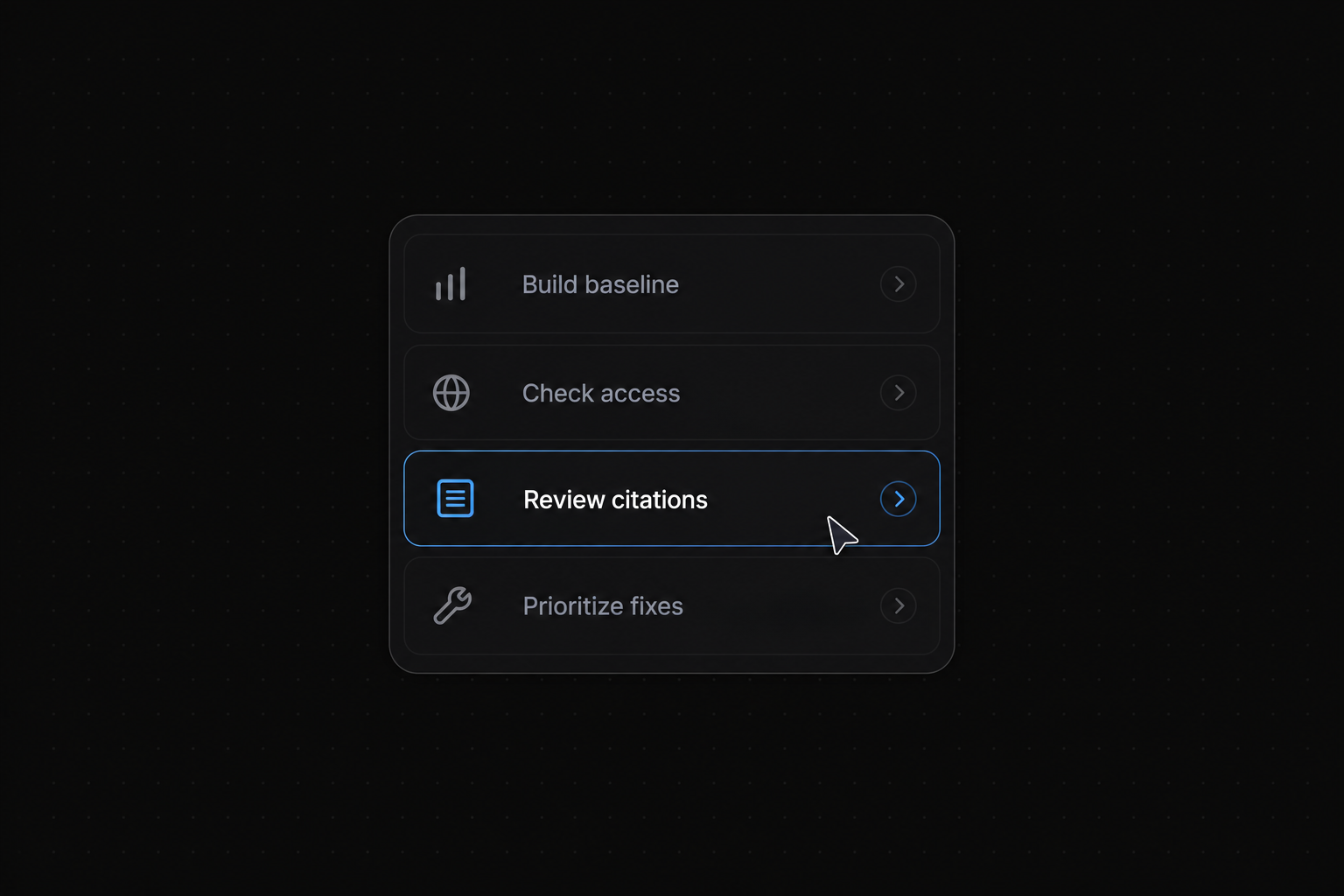
Start with the questions customers ask. Check whether the relevant pages are accessible, review the answers those questions produce, and identify the information and sources behind them. Then turn the findings into a short list of changes you can actually publish.
This guide gives marketing teams in the United States and Canada a repeatable audit process. You will build a baseline, separate mentions from citations, inspect content gaps, and connect the work to useful visits and signups. You do not need to start with hundreds of prompts or an expensive redesign.
What an AI visibility audit measures
AI visibility describes how your brand or content appears in the AI responses you monitor. An audit is a structured review of those appearances, the questions that produced them, and the pages or outside sources associated with the answers. Answer engine optimization, usually shortened to AEO, focuses on helping people find useful information through answer-based search experiences.
Keep five outcomes separate. A mention names your business. A citation links to your website or another source. A recommendation presents your business as an option for the user's needs. A visit happens when someone reaches your website. A signup is a further action after arrival.
These outcomes overlap, but they are not interchangeable. Your guide can be cited without your product being recommended. Your brand can be recommended through an outside review without a link to your website. A visitor can also read about you in an answer and return later through branded search.
Write the audit objective in business terms. For a software company, that might be appearing in questions about its main use case and giving qualified visitors a clear trial path. For a local service business, it might be accurate coverage for services offered in a specific city.
Choose the audience and market before collecting answers
A useful audit starts with a narrow audience. Define the buyer's role, the problem they need to solve, the product or service they could purchase, and the geography you serve. Otherwise, the results will tell you more about a broad category than your actual opportunities.
For an English language North American campaign, treat the United States and Canada as separate markets. Availability, currency, local service areas, terminology, and buying requirements can differ. Do not add a Canadian location to a question unless that detail matters to the decision.
Suppose a project management tool targets construction teams. A question about software for a Toronto renovation company could require different evidence from a question about software for a Texas general contractor. The audit should preserve those distinctions instead of averaging them into one unexplained score.
Record the market setting used in your tracking tool and the location stated in the prompt. Those are separate fields. A country setting does not reproduce every real user's experience, so describe your results as observations from the setup you actually used.
Build a representative set of buyer questions
Gather questions from sales calls, support conversations, customer interviews, onsite search, and relevant Search Console queries. Use keyword research to understand the language around those needs, while remembering that Google search volume does not measure how frequently people ask an AI assistant a particular prompt.
Include discovery questions, comparisons, practical problems, and branded questions. Discovery asks which options exist. Comparison asks how alternatives differ. Problem questions describe a task or obstacle. Branded questions ask about your company directly.
For a content software business, a starter set could include these questions:
- Which tools help a small marketing team find content gaps?
- How can I monitor whether AI assistants mention my business?
- What should I compare when choosing an AI visibility platform?
- How do I improve an existing article before publishing another one?
- What does this particular product include?
Keep branded and unbranded questions in separate groups. Naming your business in the question changes the test. You want to understand both whether buyers discover you and whether the answers about you are accurate.
Start with a set you can review carefully. Expand when you find a missing buyer need, not simply because a larger prompt count looks more impressive.
Fix the conditions of your baseline
For each observation, save the prompt, date, platform, model label when available, country setting, search mode, and response. Record the cited URLs and the competitors named. Also note failed runs so they are not silently treated as answers where your brand was absent.
Use the same conditions for later comparisons. If you change the prompt wording, country, or platform, create a new version of the baseline. Otherwise, you may mistake a change in the test for a change in visibility.
Repeated observations help reveal variation. Choose a collection schedule you can sustain, such as a consistent weekly review, and keep the results grouped by platform. One favorable response is useful evidence to inspect; it is not enough to establish a lasting trend.
Avoid testing in a conversation that already discusses your brand when the objective is discovery. A clean conversation reduces the influence of information you supplied earlier. Your record should still acknowledge that a controlled test cannot capture every personalized interaction.
Check access and page discovery
Before rewriting content, inspect the pages that should support your target questions. Open the public URL without a login. Check that the intended information appears, that links reach the correct page, and that the page is not a draft or an obsolete duplicate.
Review robots.txt, page indexing controls, redirects, and any hosting or CDN restrictions with the person responsible for the website. Access decisions should reflect the actual policy for each service. The detailed implementation belongs in a technical review rather than an improvised marketing change.
For Google's AI Overviews and AI Mode, a supporting page must be indexed and eligible for a search snippet. Google says there are no extra technical requirements for these features. Treat that guidance as specific to Google. Google Search Central.
Check the relationship between the page and the rest of your site. Can a visitor reach it from a relevant resource, service page, or topic hub? Does a sitemap list the preferred public URL? Is the title accurate? Record what you observed instead of assuming that a successful browser visit proves every crawler can retrieve the same content.
Review mentions and citations with clear definitions
Create a simple worksheet with one row per response. Add separate fields for a brand mention, your domain being cited, a recommendation, competitor mentions, and factual problems. Keep the original answer available so someone else can check the classification.
Decide what counts before calculating rates. For example, a brand mention can mean at least one explicit reference to your company in a completed response. A domain citation can mean at least one visible link to an approved domain. A recommendation needs an agreed definition, such as inclusion among suggested options.
An illustrative example shows why definitions matter. If a fictional business appears in eight of twenty completed responses, its observed mention rate is 40 percent. If its website is cited in three, its domain citation rate is 15 percent. Those numbers describe this sample, not the entire market.
Count each response once for those rates even if the brand appears several times. Keep multiple links as a separate citation count if useful. Exclude technical failures from completed-response denominators and show how many failures occurred.
Inspect the sources behind the answer
Open the cited pages and ask what role each one plays. A vendor page may support a feature claim. A review may inform a comparison. A standards document may support a technical explanation. A directory may establish that a business operates in a particular location.
A repeated citation is a lead for investigation, not proof that the source has a permanent special status. Look at the specific question and the evidence the page provides. A competitor may be cited because its tutorial answers one narrow step especially well.
Build a source gap list. Record the question, cited page, relevant section, information your website lacks, and the action you control. That action might be updating documentation, improving a comparison, correcting a public business profile, or preparing evidence for independent editorial coverage.
Keep owned content and outside coverage separate. You can improve your product page directly. You cannot responsibly promise that an independent publication will mention you. Pursue accurate listings and useful contributions without buying fake reviews or manufacturing endorsements.
Assess whether your page answers the buyer's question
Read the target page as a prospective customer. Can the reader quickly tell who the page is for, what problem it solves, and what conditions affect the answer? Does it provide the information needed to make a decision?
Look for missing details that have commercial consequences. A Canadian buyer may need to know whether the product is available in Canada. A software evaluator may need supported integrations, implementation steps, or a clear explanation of usage limits. A service buyer may need a realistic coverage area.
Original evidence can make a page more useful. Add a tested walkthrough, a clearly explained example, a genuine customer quote with permission, or a comparison based on documented criteria. Label hypothetical examples so readers do not confuse them with customer results.
Organize the content around the reader's task. Use descriptive headings, explain terms when they first appear, and place qualifications beside the claims they limit. Additional words are useful only when they answer something the buyer actually needs to know.
Prioritize findings by impact and control
An audit should finish with decisions. Give each finding an owner, an affected page, a reason it matters, and the next action. A broad instruction to improve AI visibility is difficult to execute; a specific request to explain a missing integration is much easier.
Use three practical queues. Fix access or accuracy problems first. Improve pages that already serve an important buyer need next. Create new content when the need is valuable and no existing page can cover it naturally.
Consider effort alongside impact. Updating an incomplete product fact may take an hour. Publishing a credible original study may take weeks. Both can matter, but they belong in different parts of the plan.
Choose a small number of changes for the first cycle. Save the previous page version, record the publication date, and state what you expect to observe. For example, you might expect more accurate descriptions of a capability, rather than promising a specific citation rate increase.
Connect visibility work to visits and signups
The website still needs to help visitors take the next step. A person arriving from a technical guide may need a related tutorial before trying the product. Someone arriving from a tool comparison may be ready to view features or begin onboarding.
Match the call to action to that intent. Explain what happens after the click and make the destination relevant. A signup invitation works better when the article has already shown how the product relates to the reader's problem.
Measure downstream outcomes in your website analytics or CRM using your own definitions. Keep visits, qualified leads, trial starts, and activated accounts separate. A rise in tracked mentions alone does not establish that signups increased because of AI search.
Add a voluntary discovery question to a signup flow if appropriate, but treat those answers as self-reported evidence. Compare them with available referral data and customer conversations. Missing referral information should not automatically become an invented AI attribution.
Run the audit workflow in SERPY
The SERPY platform connects visibility research with content planning and improvement. Use AI Visibility to organize prompts and inspect responses, citations, and competitor appearances.
When the audit reveals missing coverage, Opportunity Discovery helps investigate search demand, competitor gaps, and existing pages. Keep the question that exposed the gap attached to the proposed change so the content team understands its purpose.
Move the selected work into Content Engine for outlining, writing, optimization, and review. Use Performance Tracking to follow page performance alongside visibility signals.
This workflow can support a better route from useful content to qualified signups. Your team still needs to check the product facts and evaluate conversion outcomes. Try SERPY for free and begin with one product, one market, and a manageable group of buyer questions.
Frequently asked questions
What is an AI visibility audit?
It is a structured assessment of how your brand and content appear in selected AI responses. A useful audit includes the prompt set, testing conditions, observed mentions and citations, relevant sources, and a prioritized action list. Its purpose is to help you decide what to improve, rather than produce an unexplained score.
How is an AEO audit different from an SEO audit?
An SEO audit often focuses on website access, indexing, content, and search performance. An AEO audit adds a review of answers to buyer questions, including brand descriptions and cited sources. There is substantial overlap in the work. Keep the measurements separate so a Google ranking is not reported as a ChatGPT citation.
Which AI platforms should a small business audit?
Choose the platforms relevant to your audience and the ones you can monitor consistently. Start with a limited scope rather than collecting shallow observations everywhere. Review the available models and country options in your tracking plan, and preserve a separate baseline for each platform you include.
How many prompts do I need for an audit?
Use enough to cover your important buyer needs and enough that you can inspect the results carefully. There is no universal correct count. A focused set covering discovery, comparisons, practical problems, and brand accuracy is more useful than a large collection of repetitive or irrelevant questions.
Should I include my brand name in every prompt?
No. Unbranded prompts test discovery, while branded prompts test information about a business the user already knows. Mixing the groups can make visibility look stronger than discovery actually is. Keep both when they serve a purpose and report their results separately.
Is a mention the same as a citation?
A mention names the business; a citation identifies a linked source. Your company can receive one without the other. Record them in separate columns and decide whether a citation to an outside review counts as third-party brand coverage or a link to your own domain.
Can I combine US and Canadian results?
You can report an overall total when the underlying samples and definitions are compatible, but retain the country breakdown. Different buyer requirements can explain different answers. An aggregate rate should use the combined counts and denominator rather than an unweighted average of two percentages.
Does allowing a crawler guarantee a citation?
No. Successful access is one diagnostic check. Your page still needs to answer the relevant question, and an observed answer may use other material. Treat an access fix as a completed technical improvement and measure subsequent visibility separately.
Do I need new content for every missing mention?
No. First check whether an existing page already addresses the need. Updating that page may be the clearest action. Create another page when the subject has a distinct purpose and enough useful information to stand on its own without duplicating your current coverage.
How often should I repeat the audit?
Set a consistent review schedule that matches your publishing pace and available resources. Review important accuracy or access problems promptly. For broader trends, compare repeated observations under the same conditions and annotate page changes instead of reacting to every individual response.
How do I know whether the audit helped signups?
Compare qualified visits and signup outcomes using your analytics and CRM, alongside the visibility observations. Check whether the landing page and onboarding experience changed during the same period. A correlation can guide further investigation, but it does not by itself isolate the effect of AI visibility.
How can SERPY help me start?
SERPY gives you a place to review tracked prompts, inspect sources, investigate content opportunities, and improve articles. Begin with a clearly defined audience and one important use case. Try SERPY for free, then use the audit findings to choose a concrete first content improvement.