

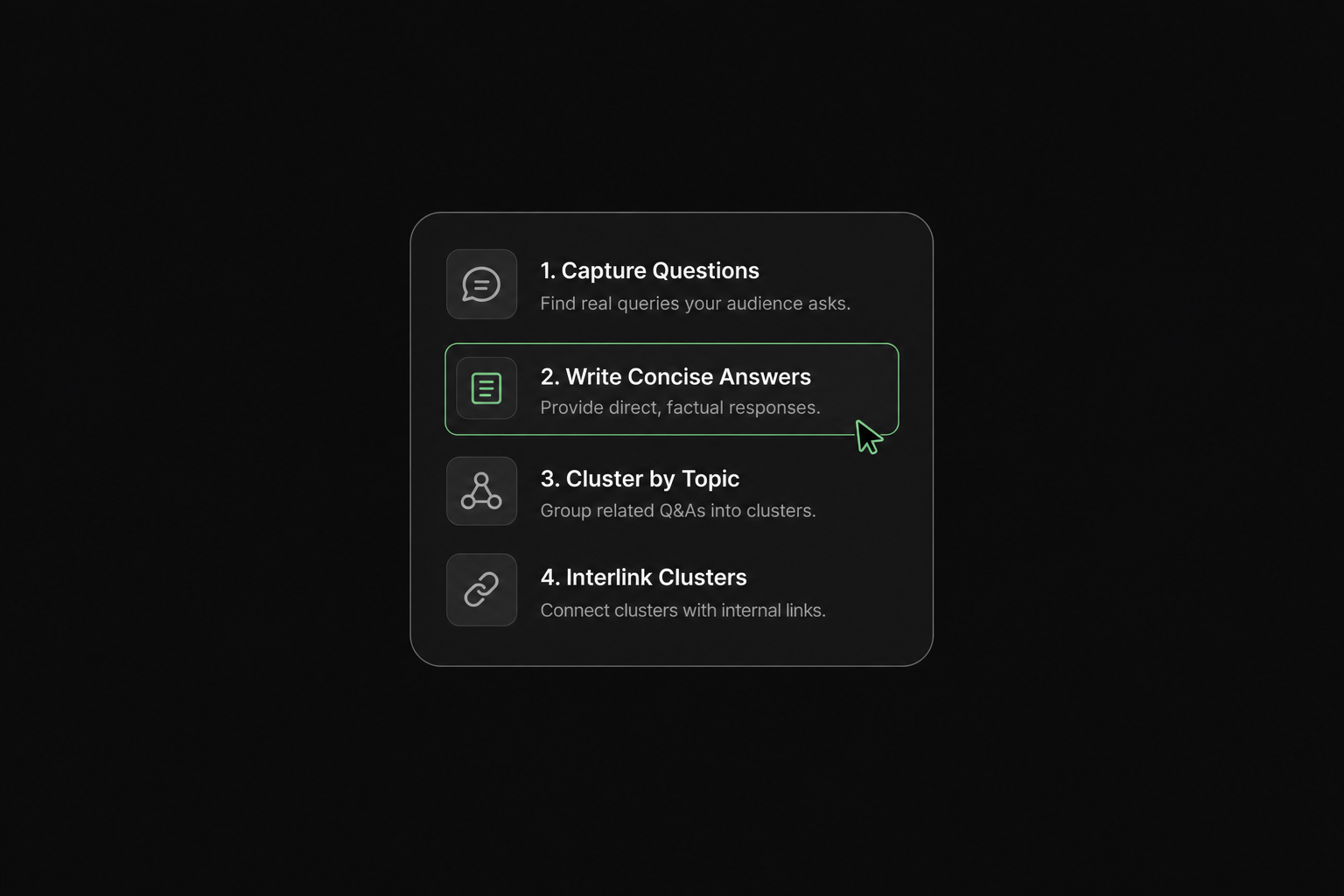
Search behavior has shifted from keyword strings to conversational prompts. If you want to survive that shift, your AI search content strategy must be engineered for retrieval models that look for concise, self-contained factual statements rather than keyword-dense landing pages.
Traditional search engines rewarded document-level optimization. You matched an exact phrase, acquired backlinks, and captured a blue link. AI search engines—like ChatGPT, Perplexity, Claude, and Google AI Overviews—work differently. They do not rank pages for humans to browse. They ingest your text, parse it into semantic fragments, and synthesize direct answers for users.
Most companies get one or the other: traditional search traffic or AI model citations. Very few win both.
And that’s the problem.
Your SEO team can optimize every page on your site and still lose AI visibility to a competitor with weaker rankings but stronger brand signals and clearer extraction points. To secure source citations across modern language models, you need a deterministic framework. This guide details how to structure content using conversational Q&A frameworks and semantic topic clusters to win consistent source citations across the modern search landscape.
How AI Search Engines Extract and Cite Source Content
To optimize for AI engines, you have to understand the retrieval-augmented generation (RAG) pipeline. Language models do not browse the live web the way a human does. When a user submits a complex prompt to an engine like Perplexity or Gemini, the system does not simply run an SQL query against an index. It converts the prompt into a mathematical vector.
The engine then performs vector search across billions of indexed passages to find text chunks with high cosine similarity to the user's intent. The engine retrieves those chunks, injects them into the context window of the model, and instructs the model to synthesize an answer while citing the source passage. The data supports this workflow across every major answer engine.
Understanding chunking mechanics is critical. Web crawlers operated by OpenAI, Anthropic, or Google do not evaluate your 3,000-word article as an indivisible asset. They segment your page into discrete semantic units—typically passages of 100 to 300 words. Each chunk is converted into an embedding and evaluated independently.
If a chunk requires context from three paragraphs above it to make sense, the embedding loses semantic clarity. The similarity score drops. The model ignores it.
Consider how this works in practice across major platforms:
- Perplexity SEO: Prioritizes recent, high-density factual snippets with clear entity attribution to populate its real-time reference cards.
- ChatGPT SEO: Looks for direct, authoritative definitions and step-based procedures that resolve multi-part user queries with zero ambient filler.
- Gemini SEO: Relies on Google's Knowledge Graph, mapping semantic entities within a passage directly to verified real-world concepts.
- Claude SEO: Excels at parsing nuanced, structured documentation where logical hierarchies and balanced arguments can be cleanly extracted.
When an engine parses your page, it looks for clean answer boundaries. If a paragraph opens with an ambiguous pronoun like "This tool does..." instead of explicitly naming the software, the chunk is degraded. The crawler cannot confirm what "this tool" refers to without ingesting surrounding chunks, which wastes context window capacity. Clear, standalone statements win citations. Ambiguous paragraphs get discarded.
Structuring Conversational Q&A Blocks for Model Ingestion
Converting traditional copy into extraction-ready text requires shifting to conversational Q&A content. In traditional keyword research, you mapped target queries like "enterprise CRM implementation timeline." In an answer engine environment, the query sounds like: "How long does an enterprise CRM take to implement for a mid-market company?"
The difference is syntax. People talk to AI models the way they talk to consultants. Your heading architecture must mirror that conversational syntax directly.
To build blocks that retrieval models extract without hesitation, follow the inverted pyramid rule for every Q&A module. The heading states the exact natural language question. The first sentence immediately below the heading must deliver an explicit, standalone answer between 30 and 50 words. Only after delivering that core answer should you expand into supporting context, trade-offs, and examples.
Why? Because RAG extractors are biased toward density. When a model scans a candidate passage, an answer-first sentence provides immediate semantic relevance. It matches the user's query vector instantly.
Here is what this looks like in practice:
Traditional keyword-first structure (poor extraction potential):
CRM Setup Time
When you're thinking about getting started with a new system, timing is everything. Many organizations wonder about the journey ahead. Depending on various unique business factors, the process can often be quite involved, taking anywhere from a few weeks to several quarters depending on your team's dedication and your chosen vendor's professional services availability.
Conversational Q&A structure (high extraction potential):
How long does an enterprise CRM implementation take?
An enterprise CRM implementation typically takes between three to nine months for mid-market companies. The timeline depends on three primary variables: data migration complexity from legacy systems, the number of custom API integrations required, and user acceptance testing across departmental teams.
Notice the difference. The second example answers the prompt in the very first sentence. It states specific timeframes. It names the causal factors. A retrieval model can extract that single 42-word paragraph and present it as a complete, cited answer with zero editorial edits required.
Better clarity? You win. Specific data points? You win. Vagueness loses every single time.
Apply these drafting rules across all core editorial sections:
- Write question headings using natural conversational syntax: what, how, why, and how much.
- Open the answer paragraph with a direct subject-verb-predicate structure that addresses the prompt immediately.
- State hard numbers, concrete timeframes, and specific entities within the first two sentences.
- Eliminate transitional throat-clearing such as "It is important to remember" or "When considering this topic."
- Use bullet points to break down multi-part components, allowing models to extract clean structural lists.
Designing Semantic Topic Clusters for Retrieval Depth
Individual Q&A blocks earn individual citations. But semantic topic clusters earn systemic domain authority. AI search engines do not rely solely on single-page relevance; they evaluate topical authority across interconnected entities.
Kevin Indig’s research on AI search visibility highlights that search engines evaluate a site’s entity footprint across an entire topic domain. A single isolated article about machine learning models will rarely win a citation if the rest of your site publishes generic lifestyle content. The retrieval model seeks authoritative sources demonstrating verified topical depth.
This requires building entity-dense cluster architecture. In this model, you create a central pillar page that defines a macro topic, supported by tightly focused child pages that resolve specific, high-intent sub-queries.
Consider an architecture built around cloud data warehouse migration:
- Core Hub: Cloud Data Warehouse Migration Architecture and Strategy.
- Child Page 1: Schema Conversion Protocols for Legacy Relational Databases.
- Child Page 2: Calculating Network Egress Costs During Large-Scale Data Transfers.
- Child Page 3: Minimizing Pipeline Downtime During Parallel Warehouse Execution.
- Child Page 4: Post-Migration Data Validation and Query Latency Benchmarking.
Notice how every child page targets a specific, highly technical entity relationship. You are not creating generic variations of the same keyword. You are establishing nodes on an informational graph.
Interlinking within these semantic topic clusters must follow explicit parent-child and lateral relationships. Every child page must link back to the hub using descriptive, entity-rich anchor text. Furthermore, child pages that share technical dependencies must link to one another directly. When search crawlers process these link paths, they construct a localized knowledge graph of your domain.
In my experience, the depth of the topic cluster matters just as much as domain authority—if not more. When an LLM determines which sources to trust for a complex technical prompt, it prioritizes domains that cover the primary entity, secondary entities, and adjacent problem spaces comprehensively. That gap is the opportunity. When your competitors publish broad surface-level overviews, you build deep entity clusters that answer every operational question downstream.
Integrating Answer Engine Optimization (AEO) into Your Editorial Workflow
Treating Answer Engine Optimization (AEO) as an afterthought at the end of the writing process does not work. AEO must be baked into the editorial workflow from outline creation to final code deployment.
Traditional SEO teams write for human dwell time and search engine algorithms simultaneously, often resulting in long-winded introductions designed to keep users scrolling. For AEO, filler text is toxic. Extraneous paragraphs dilute the semantic vector of the page, lowering the similarity score during retrieval. Every paragraph must either define an entity, explain a mechanism, or supply verifiable data.
Update your content optimization checklist to enforce these five editorial standards:
- Enforce pronoun discipline: Replace all ambiguous pronouns ("it," "they," "this system") in the first sentence of every section with the proper noun or explicit entity name.
- Maintain strict heading hierarchies: Never skip levels. An H2 must be followed by an H3, never an H4. Use headings as conceptual containers where each subsection can be pulled as an isolated unit.
- Include structured entity lists: Present comparative features, technical specifications, and step-by-step processes as clean HTML unordered or ordered lists rather than buried within text blocks.
- Add immediate quantitative evidence: Back every core claim with specific percentages, timeframes, or documented metrics immediately within the text chunk.
- Deploy technical schema markup: Use structured data to translate your page layout into machine-readable entity definitions.
Structured data provides unambiguous context to crawlers. By wrapping your conversational modules in FAQPage and TechArticle schema, you tell the engine exactly which strings represent the question and which strings represent the verified answer.
Here is an example of an extraction-ready JSON-LD implementation:
{
  "@context": "https://schema.org",
  "@type": "FAQPage",
  "mainEntity": [{
    "@type": "Question",
    "name": "How does vector retrieval select content chunks in AI search?",
    "acceptedAnswer": {
      "@type": "Answer",
      "text": "Vector retrieval converts web content into high-dimensional numerical embeddings. When a user submits a conversational prompt, the search engine calculates the cosine similarity between the prompt embedding and indexed content chunks, retrieving the closest semantic matches to synthesize the final cited response."
    }
  }]
}
When an AI crawler encounters clean JSON-LD paired with matching on-page HTML headings, the validation cost drops to zero. The model does not need to guess where the answer begins and ends. You handed it the exact text block ready for synthesis.
Tracking Brand Mentions and Citation Coverage Across AI Models
You cannot manage what you do not measure. Traditional rank tracking monitors whether your URL sits at position three or position seven for a ten-blue-links results page. In conversational search, position rankings do not exist. There is only inclusion or exclusion.
Either the language model cites your brand as a source, recommends your product in its synthesized response, or it does not. The metric that matters in 2026 is share of voice inside synthesized answers.
Tracking this requires a dedicated AI search visibility platform that systematically queries models like ChatGPT, Claude, Perplexity, and Gemini with hundreds of prompt variations. You must evaluate two distinct visibility outputs:
- Direct source citations: Your domain URL is linked directly in the reference annotations or footnote cards generated by the platform.
- Brand entity recommendations: The model includes your company, product, or methodology in the generated text as an authoritative solution, even if an explicit hyperlink is omitted.
So, what does this mean in practice? It means your reporting workflow must run regular citation gap audits. Identify the high-intent prompts where your target competitors are currently cited, but your domain is missing.
Analyze the source URLs the engine used to build that response. Did the competitor win because they had a concise conversational Q&A block answering the precise sub-query? Did they win because a third-party review site mentioned their product entity alongside specific features? Once you identify the extraction source, update your topic cluster to fill the factual void.
Frequently Asked Questions
What is conversational Q&A content in AI search?
Conversational Q&A content refers to web copy structured around full natural-language questions and direct, self-contained answers designed to be cleanly extracted and cited by retrieval-augmented generation (RAG) engines. Unlike traditional keyword-targeted FAQs, conversational Q&A modules address complete conversational queries and provide immediate 30 to 50-word answers before offering deeper context.
How do semantic topic clusters improve AI search visibility?
Semantic topic clusters establish dense entity relationships across your website. When LLMs evaluate source reliability for a specific query, broad topical coverage across interlinked documents increases the model's confidence in citing the domain. Comprehensive coverage of primary and secondary entities signals verified topical depth to retrieval systems.
How is AEO different from traditional SEO?
Traditional SEO targets ranking position on a ten-blue-links results page via keyword targeting, technical crawling optimizations, and backlink authority. AEO (Answer Engine Optimization) targets inclusion and citation within synthesized natural-language summaries generated by large language models by optimizing content chunking, semantic clarity, and factual extractability.
How can I get my business featured in AI engine recommendations?
To get featured in AI engine recommendations, structure clear product definitions on your site, publish comparative entity data, secure mentions across authoritative industry sources used in training corpora, and publish modular Q&A sections directly answering buyer queries. AI models prioritize brands with consistent entity attributes verified across multiple trusted sources.